
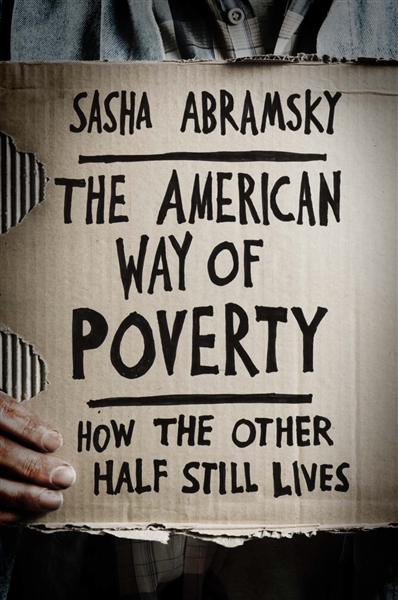
Five years after the depth of the Great Recession, at a time when the wealth gap in America is at extremes – a new analysis finds it at its widest point since the Roaring 20s – journalist Sasha Abramsky has a new portrait of one end of that great divide.
Abramsky traveled across this country, and interviewed hundreds of people, both the newly poor and the long-term poor, for his book, The American Way of Poverty: How the Other Half Still Lives. Abramsky’s project comes 50 years after Michael Harrington’s groundbreaking 1962 report on poverty, The Other America. Like Harrington, Abramsky wants to grab America by the throat and say, “look!,” and also, “do something!”
Abramsky lays out his own blueprint for action; he wants a new “war on poverty:” what he calls a public works fund to protect against mass unemployment; an educational opportunity fund to expand access to and affordability of higher education; a poverty-mitigation fund; and money to stabilize Social Security and reduce the deficit, made possible by higher taxes on the wealthy.
Abramsky spoke with NBC News.
NBC News: Over 50 years ago, Michael Harrington warned that unless attention was paid, and something was done, somebody in a future generation would write another book about “the other America,” and it would be the same story, or worse. Are you that somebody Harrington was talking about, and is it indeed the same story, or worse?
Abramsky: Certainly Harrington was the inspiration for what I was doing. It’s the same in some ways, it’s different in other ways. One of the things the war on poverty was most successful at was massively reducing the poverty of the elderly. And that’s still the case. A far lower percentage of America’s elderly today are poor [as a result]. We’ve done a less good job eliminating child poverty. A lot of the conditions for kids I talked to would be very familiar to Harrington. And the geographic areas he wrote about – inner city slums, Appalachia, the Mississippi Delta – those areas still are very poor.
On the other hand, one of the things Harrington wouldn’t have found that anybody writing about poverty today does find is suburban poverty, people who on the surface have it all – they have these big houses, these big cars, swimming pools – but it’s a charade, because they’re under water on their mortgages, a lot of them are out of work, their economic security has disappeared, they’ve got huge amounts of debt, and a lot of them end up on food lines. Harrington wouldn’t have seen the suburbanization of skid row.
More from Barbara Raab NBC News
Posted by Libergirl
 TheConfirmationFiles